The Ten Commandment Tablets
By Colin Grey
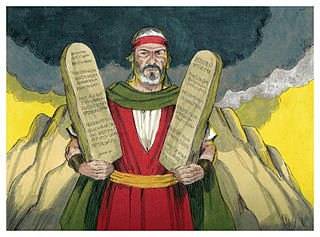
You may often see depictions of Moses carrying these huge tombstone sized tablets of stone with the ten commandments written on them. Now an average tombstone might be 70kg. However, if you read the scripture you will note:
- Moses was 80 years old (Exodus 7:7)
- There were two tablets (Exodus 31:18)
- Moses carried both of them in one hand (Exodus 32:15)
- They were written on both sides (Exodus 32:15)
I hope now you are beginning to see the problem I have with such pictures.
Another thing is that they are often depicted with five commandments on one and five on the other. At first this seems reasonable, but when you study ancient middle eastern cultures you find out that covenants (this is part of a covenant between God and Israel) were often written down. Short term ones were written on papyrus paper (which unless kept very dry would not last very long), but long lasting or everlasting covenants were written on stone. In either case two copies of the covenant were made one for each party, in much the same way as we do in modern times with contracts. More on this later.
So how big were the tablets? We know that both tablets fitted in the Ark of the Covenant and we know the external dimensions of that. They are given as two and a half cubits by one and a half cubit in Exodus 25:10. A cubit is about 1.5 feet so we have dimensions about 3 3/4 feet (1.14m) long by 2 1/4 feet (0.68m) wide. There is going to be some taken off that for the thickness of the wood, and of course they could be a lot smaller than that. According to Bava Batra in the Talmud, the length and width of each of the Tablets was six Tefachim, and each was three Tefachim thick - respectively roughly 20 (0.508 m) and ten inches (0.254 m). I would say that thickness is too much but otherwise that sounds about right to me. In Hebrew thought a square shape indicated perfection. Note that artistic depictions often show rounded top corners, but it is much more likely that they had square corners.
Back to ancient covenants. I have said that two copies were made on stone. The tradition was that each party would store a covenant in what they considered to be their most sacred place. As both copies of the ten commandments were kept in the Ark of the Covenant, then it meant that Moses considered that the Ark of the Covenant was his most sacred place, and that God also considered the Ark of the Covenant was His most sacred place (at least on earth).
Back to list of articles
The image was from Wikimedia Commons by Distant Shores Media/Sweet Publishing as part of a cooperation project. Sweet Publishing released these images, which are taken from now-out-of-print Read'n Grow Picture Bible Illustrations (Biblical illustrations by Jim Padgett, courtesy of Sweet Publishing, Ft. Worth, TX, and Gospel Light, Ventura, CA. Copyright 1984.), under new license, CC-BY-SA 3.0